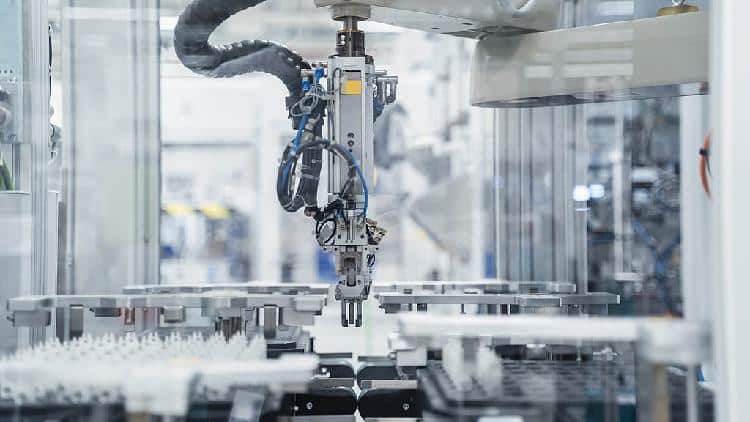
What Is Aluminum Die Casting? Process, Alloys, Design Rules and Applications
Χύτευση αλουμινίου υπό πίεση is a net-shape metal forming process in which molten aluminum alloy is injected at high speed and pressure into a reusable hardened steel die. The result is a thin-wall, dimensionally repeatable part produced in a cycle of roughly 30 to 90 seconds for small and medium castings. For engineers and buyers, it is the standard route to lightweight housings, brackets and structural components once annual volumes justify the tooling.

This guide explains how high pressure die casting (HPDC) works, which alloys are used, what the tooling and design rules look like, and where the process succeeds or fails.
Aluminum Die Casting at a Glance
| Στοιχείο | Typical value |
|---|---|
| Process type | Cold-chamber high pressure die casting |
| Molten metal temperature | About 650 to 700 °C for A380 |
| Die material | 8407,8418,1.2344ESR tool steel, typically 48 to 52 HRC |
| Machine clamp force | From a few hundred to several thousand tons (80-3500 ton) |
| Typical wall thickness | About 1.5 to 4 mm (down to about 1 mm on small features) |
| As-cast tolerance | Roughly ±0.1 mm on small features; confirm per drawing, post machining can reach -/+0.01mm |
| Economic volume | Generally thousands to millions of parts per year |
These are typical industry ranges. Actual capability depends on part geometry, alloy, χύτευση σε μήτρα mold design and the foundry’s process control.
How High Pressure Die Casting Works
Aluminum is die cast on cold-chamber machines. Molten metal is held in a separate furnace and ladled, by hand or by an automatic ladle, into a shot sleeve for every cycle. Molten aluminum attacks the submerged pumping components of hot-chamber machines (used for zinc or magnesium alloy), so the metal must stay out of the injection system until the shot.
A typical cycle runs as follows:
- Die close and lock. The moving platen closes the two die halves and the clamping system locks them. Clamp force must exceed the metal pressure multiplied by the projected area of casting, runners and overflows, plus a safety margin.
- Ladling. A measured dose of molten alloy enters the shot sleeve. Dose repeatability affects shot weight, biscuit thickness and porosity.
- Slow shot. The plunger advances at roughly 0.2 to 0.5 m/s to push the metal forward and expel air from the sleeve without entraining it.
- Fast shot. The plunger accelerates, typically to 2 to 6 m/s, and forces metal through the gate at about 30 to 60 m/s. The cavity fills in tens of milliseconds.
- Intensification. Pressure is boosted to compensate for solidification shrinkage. Metal pressures of roughly 30 to 100 MPa are common, depending on the part and machine.
- Solidification and cooling. The casting solidifies within seconds, controlled by die temperature and cooling or heating circuits.
- Die open and ejection. Ejector pins push the casting out, often removed by a robot.
- Die spray and trim. A release agent is applied to the die, and runners, overflows and flash are removed in a trim press.
The quality of a die casting part is largely decided in steps 3 to 5. The plunger velocity profile, gate velocity and intensification timing are the main process levers.

Aluminum Die Casting Alloys
Aluminum alloy is the most widely cast non-ferrous metal because it combines low density (about 2.75 g/cm³), good strength-to-weight ratio, corrosion resistance and thermal and electrical conductivity. Most die casting alloys are aluminum-silicon systems, because silicon improves fluidity and reduces solidification shrinkage.
| Κράμα | Key characteristics | Typical as-cast UTS (MPa) | Typical elongation |
|---|---|---|---|
| A380 | General-purpose; best balance of castability, strength and cost | ~320 | ~3.5% |
| A383 / ADC12 | Better die filling for thin or complex parts; close but not identical equivalents | ~310 | ~3.5% |
| A360 | Higher corrosion resistance and pressure tightness; harder to cast | ~317 | ~3.5% |
| A413.0 / ADC1 | Very good fluidity and pressure tightness; suited to thin walls | ~296 | ~2.5% |
| B390 | High silicon; wear resistant; low ductility | ~316 | ~1% |
Values are approximate; confirm against the alloy standard or the mill certificate. Alloy designations differ by region (ASTM, JIS, EN, GB), so cross-reference carefully rather than assuming one-to-one equivalents.
Key selection factors:
- Castability (fluidity, hot tearing resistance, die soldering tendency).
- Αντοχή στη διάβρωση, which drops as copper content rises.
- Pressure tightness for hydraulic, fluid and gas parts.
- Κατεργασιμότητα and surface treatment. High-silicon alloys wear tools faster and give poor decorative anodizing.
- Θερμική αγωγιμότητα for heat sinks and LED or telecom housings.
Tooling: Die Design and Thermal Management
The die is typically the largest up-front investment and the main driver of casting quality. A production καλούπι χύτευσης includes the cavity and core inserts, a gating system, overflows, vents, ejection, cooling channels and often slides.
Gating. Metal should enter at a controlled velocity and fill the cavity progressively. Gate position, thickness and area set the fill pattern and the pressure drop. A poor gate shows up as cold shuts, flow lines and soldering at the gate.
Overflows and venting. Overflows trap the leading, cooler metal and entrained oxides and air. Vents and vacuum ports let displaced air leave in milliseconds.
Thermal balance. Die surface temperatures commonly run at about 150 to 250 °C in production. Uneven cooling causes distortion, soldering on hot spots and cold shuts on cold areas. Hot spots are often addressed with spot cooling or high-pressure water jets.
Die steel and life. H13 premium-grade tool steel is standard. Thermal fatigue (heat checking) is the main wear mechanism, and die life depends on alloy, thermal cycling, spray practice and maintenance.

Design for Die Casting: Practical Rules
| Χαρακτηριστικό γνώρισμα | Typical guideline |
|---|---|
| Πάχος τοιχώματος | Uniform, about 1.5 to 4 mm; avoid abrupt thickness changes |
| Draft | About 1-5° on external walls, 1 to 2° on internal walls and cores |
| Fillets and radii | Generous radii (often R1 to R3 mm) to improve flow and reduce stress |
| Ribs | At or below adjacent wall thickness to limit shrinkage and sink |
| Bosses | Core out and support with ribs rather than leaving a solid mass |
| Machining stock | About 0.3 to 0.8 mm on critical faces |
| Undercuts | Possible with slides, but each slide adds tooling cost and maintenance |
Thick sections and isolated heavy bosses are the most frequent source of shrinkage porosity. If a feature needs strength, add ribs and radii instead of mass. Involve the die caster at concept stage, because simulation of fill and solidification can prevent costly die changes.
Common Defects and How Process Control Prevents Them
| Ελάττωμα | Typical cause | Typical remedy |
|---|---|---|
| Gas porosity | Air entrapment, lubricant gas, hydrogen in melt | Optimize shot profile, venting, vacuum, melt degassing |
| Shrinkage porosity | Thick sections, insufficient intensification | Redesign thick areas, localized cooling, squeeze pins |
| Cold shut | Low metal or die temperature, poor gating | Increase temperatures, improve gate and overflow design |
| Soldering | Hot spots, high iron deficiency, poor release | Improve cooling, spray coverage and alloy iron control |
| Flash | Insufficient clamp force or die wear | Check tonnage, die fit and parting line condition |
| Blisters | Subsurface gas expanding during heat or coating | Reduce gas porosity; avoid high-temperature steps |
Iron content in die casting alloys is deliberately kept above a minimum, because iron reduces die soldering. It also forms brittle intermetallics, so chemistry control matters.
Process Variants: Vacuum, Squeeze and Structural Casting
Conventional HPDC traps some gas in the casting. Several variants reduce it.
- Vacuum-assisted HPDC evacuates the cavity and shot sleeve before and during the shot. It lowers gas porosity, improves mechanical properties and can make heat treatment viable.
- Squeeze casting applies high pressure during solidification, in a slower fill, for denser parts.
- Structural die casting uses low-iron alloys, high vacuum and robust thermal control for safety-critical or large body structures.
Non-vacuum castings are generally not solution heat treated, because entrapped gas can cause blistering. If your part needs T5, T6 or T7 tempers, discuss a vacuum-capable process with the supplier early.
Secondary Operations and Quality Control
Most aluminum die castings need at least one downstream step. Common operations are trimming, deburring, shot blasting, CNC machining of sealing faces, bores and threads, impregnation for pressure tightness, painting, powder coating, chromate conversion and assembly.
A capable supplier verifies quality with more than visual inspection:
- Real-time X-ray to observe fill characteristics and locate internal porosity.
- CMM (coordinate measuring machine) dimensional layout and first-article reports.
- Optical emission or spectrometer analysis to verify alloy chemistry.
- Statistical process control and process capability studies (Cp and Cpk) on critical dimensions.
- Leak testing and cleanliness testing where the application requires it.
When reviewing a supplier, ask which of these are actually performed in house and on which characteristics, rather than relying on a general quality statement. Certifications such as ISO 9001 or IATF 16949 are useful signals, but check the scope and the certificate’s expiry date.
Advantages and Limitations
Πλεονεκτήματα
- High production rate and low cost per part at volume.
- Thin walls and complex geometry in a single shot.
- Good dimensional repeatability and surface finish.
- Lightweight parts with good thermal conductivity and EMI shielding.
- Integrated features (bosses, ribs, mounting points) that reduce assembly.
- Aluminum scrap is fully recyclable.
Περιορισμοί
- High die casting tooling cost and long lead time for the first parts, often 8 to 16 weeks.
- Porosity limits fatigue performance and weldability.
- Practical size limits tied to machine tonnage.
- Design changes after die build are expensive.
- Not economical for very low volumes.
Τυπικές εφαρμογές
Aluminum die casting is found wherever lightweight, moderately complex metal parts are needed in volume:
- Αυτοκίνητο: transmission cases, engine and e-motor housings, brackets, steering and brake components, battery enclosures.
- Industrial and agricultural equipment: housings, valve bodies, pump parts, conveyor components.
- Electrical and lighting: heat sinks, connectors, LED housings.
- Telecommunications and electronics: enclosures and RF housings requiring shielding.
- Consumer and recreational: power tool bodies, grills, motorcycle and ATV parts, chair bases.
- Aerospace, marine and defense: non-critical housings and fittings where specifications permit.
Die Casting vs Other Processes
Sand casting suits low volumes and large parts, but has rougher surfaces and needs more machining. Investment casting handles intricate shapes and zero draft but costs more per part. CNC machining needs no tooling and gives tight tolerances, but its unit cost remains high. Aluminum die casting overtakes these routes at moderate to high volumes with thin-wall, near-net-shape geometry.
Supplier Selection Checklist
- Machine range and tonnage that match your part size and volume.
- Automation (robotic extraction, automatic ladles) for consistency.
- In-house die maintenance and tool room capability.
- Real-time X-ray, CMM and SPC for process proof.
- Machining, finishing and leak-test capability under one roof.
- Engineering support for design for manufacturability (DFM) and simulation.
- Experience with your alloy, industry and quality system.
ΣΥΧΝΈΣ ΕΡΩΤΉΣΕΙΣ
What is aluminum die casting used for? It produces lightweight housings, brackets and structural parts for automotive, industrial, electrical and consumer products.
Is die cast aluminum strong? It has a good strength-to-weight ratio, with typical as-cast tensile strength around 300 MPa for common alloys, but lower ductility and fatigue strength than wrought aluminum because of porosity.
Why use cold-chamber machines for aluminum? Molten aluminum would attack the pumping system of a hot-chamber machine, so metal is ladled into a separate shot sleeve for each cycle.
What tolerances can die casting hold? About ±0.1 mm on small as-cast features is typical, and tighter dimensions are achieved by CNC machining after casting.
How many parts can one die produce? Die life depends on alloy, geometry and maintenance, and can reach hundreds of thousands of shots. Ask your supplier for an estimate for your part.
Can aluminum die castings be anodized? Yes, but common high-silicon, copper-bearing alloys give a dull, less uniform finish. Powder coating or chromate conversion is more common.